
👤 Users: 0 | 👁 Guests: 1 | 🌍 Total: 1
Eruptive syringomas = الاسطوانوم الاندفاعي
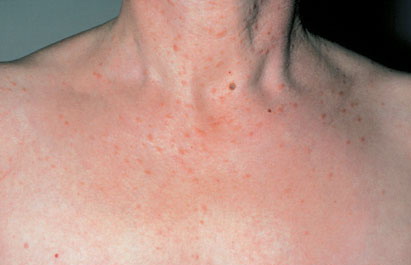
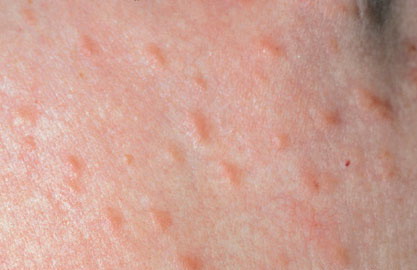
Eruptive syringomas
Syringoma is a benign adnexal neoplasm formed by well-differentiated ductal elements. The name syringoma is derived from the Greek word syrinx, which means pipe or tube.
Based on Friedman and Butler’s classification scheme, 4 variants of syringoma are recognized: (1) a localized form, (2) a form associated with Down syndrome, (3) a generalized form that encompasses multiple and eruptive syringomas, and (4) a familial form.
Pathophysiology
Syringoma is generally considered a benign neoplasm that differentiates along eccrine lines.
Enzyme immunohistochemical tests demonstrate the presence of eccrine enzymes such as leucine aminopeptidase, succinic dehydrogenase, and phosphorylase. The immunohistochemical pattern of cytokeratin expression indicates differentiation toward both the uppermost part of the dermal duct and the lower intraepidermal duct (ie, sweat duct ridge). However, distinguishing between eccrine and apocrine ducts is sometimes difficult, and many tumors that were traditionally thought to be eccrine have been shown to have apocrine differentiation. Electron microscopy of syringomas demonstrates ductal cells with numerous short microvilli, desmosomes, luminal tonofilaments, and lysosomes. The histogenesis of syringomas is most likely related to eccrine elements or pluripotential stem cells.1
Some investigators have suggested that cases of eruptive syringoma may represent a hyperplastic response of the eccrine duct to an inflammatory reaction rather than a true adnexal neoplasm. In this setting, these authors propose the term syringomatous dermatitis for such cases. Likewise, the scalp “syringomas” seen in scarring alopecia represent a reactive proliferation in response to the fibrosis.
History
Syringomas are asymptomatic. However, in some rare cases, they have been associated with pruritus, especially in the setting of perspiration.2 Uncommonly, the patient may have a family history of similar lesions. Rarely, syringomas may be associated with the Brooke-Spiegler syndrome, an autosomal dominant disease characterized by the development of multiple cylindromas, trichoepitheliomas, and occasional spiradenomas.3 Additionally, syringomas may be associated with Down syndrome.4,5,6
Physical
The appearance of syringomas is as follows:
- Syringomas are skin-colored or yellowish, small, dermal papules
- Sometimes, the lesions may appear translucent or cystic.
- The surface of syringomas can be rounded or flat.
- Syringomas are usually smaller than 3 mm in diameter.
- Eruptive syringomas typically appear as hyperpigmented papules on the chest or penile shaft.
The distribution of syringomas is as follows:
- Syringomas are usually multiple, arranged in clusters, and symmetrically distributed.
- Most commonly, syringomas are limited to the upper parts of the cheeks and lower eyelids.
- Other characteristic sites for syringomas include the axilla, chest, abdomen, penis, and vulva.
- Case reports have described syringomas limited to the dorsum of the hands.7
- In the variant of eruptive syringoma, multiple lesions appear simultaneously, typically on the chest and lower abdomen. The eruptive variant may involve the penis.8
- Rarely, syringomas appear as unilateral, linear, nevoid lesions.9
Differential diagnoses and related conditions are as follows:
- In rare instances, scalp syringomas can produce scarring alopecia.10
- On occasion, syringomas can be associated with milia and vermiculate atrophoderma.11
- In rare cases, syringoma can be associated with steatocystoma multiplex.2
- Clinically, syringomas on the face must be distinguished from trichoepitheliomas and basal cell carcinomas.
- Lesions on the eyelids may be confused with xanthelasmas.
- Eruptive syringomas on the trunk can resemble disseminated granuloma annulare.
- Microcystic adnexal carcinoma can masquerade as syringoma.12
- Lesions of Fox-Fordyce disease (multiple pruritic follicular papules) should be differentiated from syringomas.13
Causes
Syringomas are frequently incidental, although some familial cases may occur. More than 10 English language cases of familial syringomas have been reported. They tend to occur in preadolescence or adolescence, have no sexual predilection, most commonly involve the face, and are inherited as autosomal dominant traits or as a result of germline or somatic mutations.
Syringomas can be associated with Down syndrome, in which case they are usually located in the periorbital region. However, rare cases of eruptive syringomas associated with Down syndrome have also been reported.4,5,6
Clear-cell syringomas may be associated with diabetes mellitus.
Surgical Care
The main reason for treatment is cosmetic; in particular, patients commonly seek treatment for syringomas of the eyelids and cheeks, which may be conspicuous. The goal of therapy for syringomas should be the destruction of the tumor with minimal scarring and no recurrence. However, because syringomas are usually embedded within the dermis, complete removal is often unsuccessful and recurrence is common.16
No comparative studies and no long-term follow-up studies are available on which to base definitive recommendations for syringoma treatment. Possible treatments include the following:
- Surgical excision with primary suturing
- Scissor excision with secondary intention healing
- Electrocautery17
- Electrodesiccation and curettage
- Carbon dioxide laser using the pinhole method of application or Er:YAG laser ablation18,19,20
- Cryotherapy
- Dermabrasion
- Trichloroacetic acid
- Oral isotretinoin and topical tretinoin16
- Application of topical atropine16