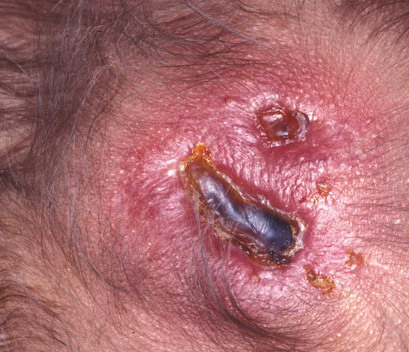
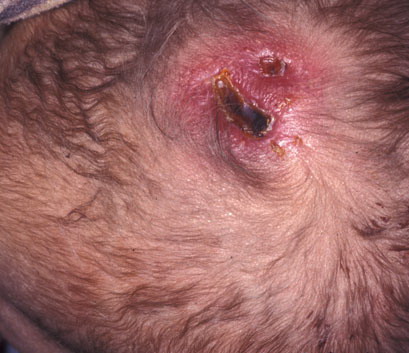
Congenital absence of skin
Congenital absence of skin is a rare condition which was first reported in
1826. Until 1960 only 213 cases hadbeen reported in the literature. It usually
presents in the newborn as localized areas of skin deficiency, most
commonly involving the scalp. The aetiology of the condition is
unknown, but various theories havebeen postulated. One of the earlier
theories was that of the amniotic adhesion theory. Intra-uterine trauma
because of pressure was also postulated.There is no doubt that
hereditary factors play a role because familial histories have been obtained.
In those cases where microscopical studies of the lesions were performed, it was found that
there was an absence of sebaceous glands, hair papillae and sweat glands in the affected
area. There was also an absence of elastic fibres in the corium of the affected area and to a
certain extent in the surrounding areas. The condition was therefore compared with
epidermolysis bullosa hereditaria, in which there is also believed to be a deficiency of elastic
fibres in the corium. Underlying defects of the skull bone are common and may be
large.The mortality in cases with scalp de¬fects is about 20%, the main cause of death
being menin¬gitis.The treatment in cases where only the scalp is deficient consists of a
Thiersch graft and later, if necessary, rotation of scalp flaps. If there is a large defect of the
underlying bone the defect should by pre¬ference be covered with a scalp flap,