▪ CLEAR CELL ACANTHOMA
Epidemiology
Clear cell acanthoma is most commonly found equally in men and women ages in the sixth to eighth decade.
Etiology and Pathogenesis
The etiology of clear cell acanthoma, also known as Degos acanthoma and pale cell acanthoma, is unknown. When initially described by Degos et al. in 1962, the lesion was thought to be benign tumor of epithelial origin.80 Although initially thought to be of follicular or sweat-gland origin, the expression of involucrin and epithelial membrane antigen by clear cell acanthomas indicates an epithelial origin. The cytokeratin staining patterns, interestingly, reveal staining patterns commonly found in inflammatory dermatoses such as lichen planus, psoriasis, and discoid lupus.84 The presence of clear cell acanthomas on psoriatic plaques has led many to question the role of inflammation in the development of these lesions.
Clinical Features
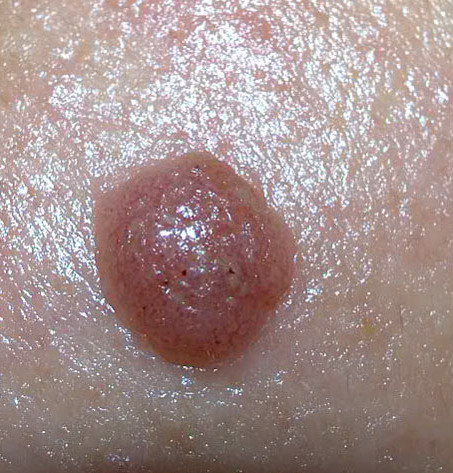
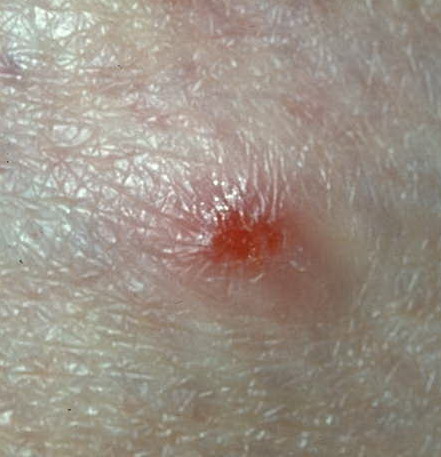
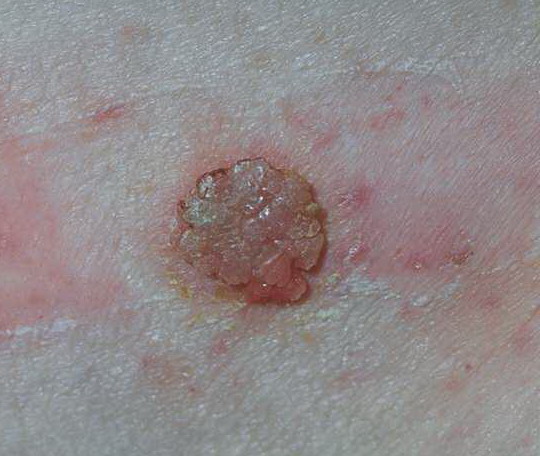
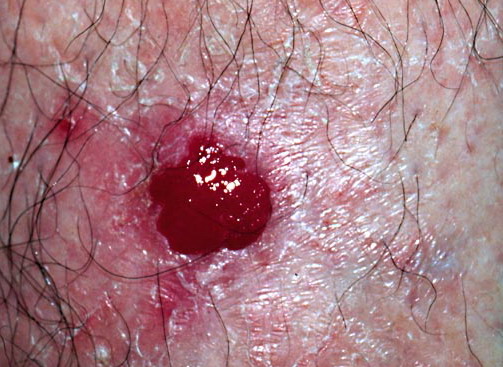
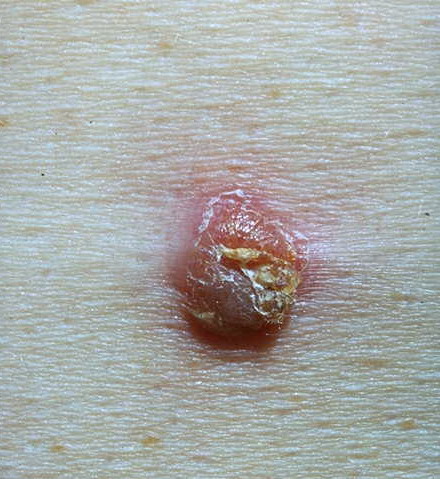
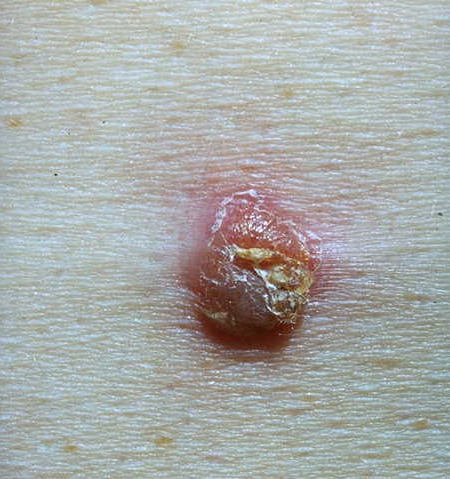
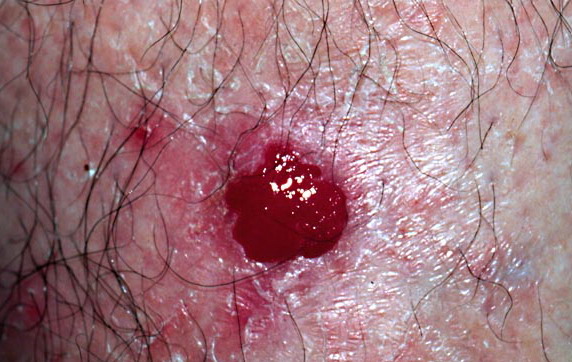
Clear cell acanthoma is commonly a solitary, shiny, erythematous to brown, well-demarcated papule or nodule that blanches almost fully with pressure .
Surrounding the lesion is a collarette of scale. These lesions range from 5 mm to 2 cm, although the giant clear cell acanthoma can measure greater than 5 cm.86 The lesions are usually found on the legs but can be located on the trunk and face. Although commonly solitary, multiple lesions have been reported. The dermatoscopic findings of the clear cell acanthoma is similar to that seen in psoriasis, with vascular puncta prominent in the lesion.87 These lesions bleed with trauma.
CLEAR CELL ACANTHOMA AT A GLANCE
- Clear cell acanthoma is a tumor of epidermal origin.
- Solitary, shiny, erythematous or orange to brown, blanching, well-demarcated papule or nodule with collarette of scale.
- Composed of distinctive, glycogen-rich keratinocytes.
- Differential diagnosis: Lichenoid keratosis, basal cell carcinoma.
Pathology
Pale-staining keratinocytes within a background of epidermal psoriasiform hyperplasia is characteristic in clear cell acanthoma . Other epidermal findings include suprapapillary plate thinning, neutrophils, and sparing of adnexal epidermis. A mixed inflammatory infiltrate, papillary dermal edema, and enlarged vessels can be seen in the dermis. The glycogen-rich keratinocytes in the epidermis stain distinctively with periodic acid-Schiff and periodic acid-Schiff with diastase.
WARTY DYSKERATOMA AT A GLANCE
- Solitary focus of acantholytic dyskeratosis
- Lesions: Solitary, skin-colored, umbilicated papules located on the head or neck
- Histology: Cup-shaped epidermal invagination with acantholysis and dyskeratosis filled with keratinaceous material
- Differential diagnosis: Actinic keratosis, squamous cell carcinoma
- Treatment: Excision
Treatment
Cryotherapy, curettage and electrodesiccation, laser ablation, or surgical excision have been used to successfully treat this lesion.