Medical Care
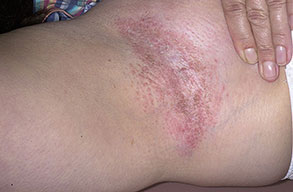
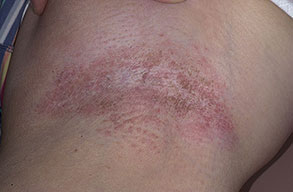
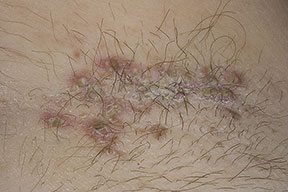
Although some consider granular parakeratosis rare, successful medical treatments for granular parakeratosis have been reported. These have included topical corticosteroids and oral and topical retinoids.24,25 A 2003 report notes that topical calcipotriene and ammonium lactate also effectively treated granular parakeratosis.10 Calcineurin inhibitors and topical antifungal agents have been tried with some success. Isotretinoin25,26 and tretinoin24 have been reported as effective for granular parakeratosis, as has botulinum toxin injection.27
Surgical Care
Rare reports have noted that cryotherapy can effectively treat granular parakeratosis.
Activity
Patients should avoid excessive washing of intertriginous areas. They should also minimize or avoid the use of roll-on deodorants and antiperspirants.
Medication
The goals of pharmacotherapy for granular parakeratosis are to reduce pruritus and to improve the appearance of the eruption that manifests with granular parakeratosis.
Retinoids
These agents are vitamin A analogues involved in modulation of cell growth, division, reproduction, and differentiation. Their biologic effects result from alterations in gene expressions that are mediated through 2 major types of nuclear receptors: the retinoic acid receptor and the retinoic X receptor. Each receptor subtype likely controls the expression of both unique genes and common genes. Subclass-specific retinoids are available. Systemic retinoids very likely are not indicated for this harmless condition, but they could perhaps be used in exceptional cases
Tretinoin (Avita, Retin-A, Renova)
Inhibits microcomedo formation and eliminates existing lesions. Makes keratinocytes in sebaceous follicles less adherent and easier to remove. Available as 0.025%, 0.05%, and 0.1% creams. Also available as 0.01% and 0.025% gels. Can be a first-line treatment in granular parakeratosis but is irritating and should be used with caution
Tazarotene (Tazorac)
Topical medication approved for psoriasis and acne. Useful in normalizing functioning of epithelial cells. Acts on a genetic level, leading to the transcription of certain retinoic acid genes. Use is off-label
Vitamins
These agents are essential for normal DNA synthesis and metabolism of proteins, carbohydrates, and fats. They may also work as cofactors used in aerobic cellular respiration
Calcipotriene (Dovonex)
Topical preparation containing vitamin D-3. Indicated for psoriasis. Seems to normalize maturation of epidermal cells.
Lactic acid (Lac Hydrin, AmLactin)
Topical medication used to treat dry skin. Relieves itching and aids in healing skin in mild eczemas and dermatoses, itching skin, minor wounds, and minor skin irritations. Found in a variety of topical emollient lotions.
.
Corticosteroids
These agents have both anti-inflammatory (glucocorticoid) properties and salt-retaining (mineralocorticoid) properties. Glucocorticoids have profound and varied metabolic effects. In addition, these agents modify the body's immune response to diverse stimuli.
Hydrocortisone (CortaGel, Cortaid, Dermacort
Adrenocorticosteroid derivative suitable for application to skin or external mucous membranes. Decreases inflammation by suppression of migration of polymorphonuclear leukocytes and reversal of increased capillary permeability. Can be a first-line treatment in this condition but can cause striae and skin thinning when used in axillary or groin areas